Nir and Far - A Blog About Behavior Engineering Nir and Far - A Blog About Behavior Engineering
Menu
Search
Archives › February, 2012
Feb 26, 2012
Habits Are The New Viral: Why Startups Must Be Behavior Experts

NOTE: This post originally appeared in Techcrunch

Here’s the gist:

  • In the age of infinite online distractions, successfulweb businesses must generate new user habits to stay relevant.
  • The strength of a web company’s user habits willincreasingly equate to its economic value.
  • Forming strong user habits is more importantthan viral growth.
  • The Curated Web will run on habits.

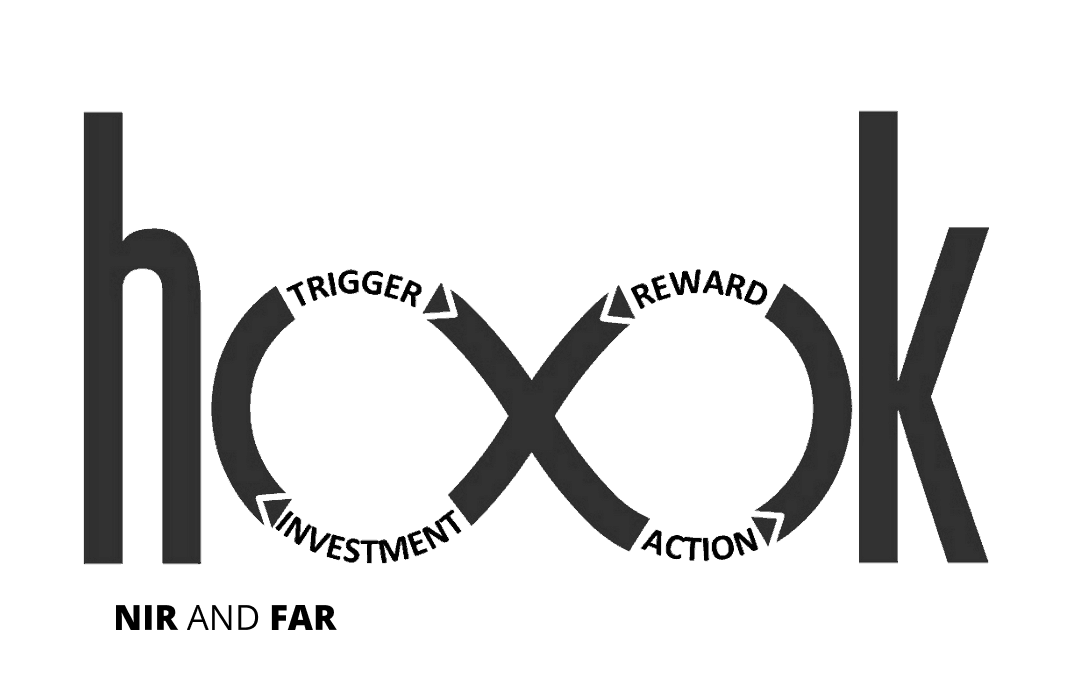
Face it; you’re hooked. It’s your uncontrollable urge to check for email notifications on your phone. It’s your compulsion to visit Facebook or Twitter for just a few minutes, but somehow find yourself still scrolling after an hour. It’s the fact that if I recommended a book to purchase, your mind would flash “Amazon” like a gaudy neon sign. If habits are defined as repeated and automatic behaviors, then technology has wired your brain so you behave exactly the way it wants you to.
In an online world of ever-increasing distractions, habits matter. In fact, the economic value of web businesses increasingly depends on the strength of the habitual behavior of their users. These habits ultimately will be a deciding factor in what separates startup winners and losers.

Read This Post
Feb 23, 2012
What Is, and Is Not, Your Product’s Job

Recently, my mom came for a visit.  She read my blog and discovered her son has a crazy habit of running barefoot.  After some convincing, she begrudgingly accepted my rationale, especially after I showed her that a nice Jewish professor at Harvard said it’s ok.

But on one morning, as I was about to walk out the door, my mom stopped me with a tight grab to the arm reminiscent of my childhood.  “It’s bad enough you run outside with bare feet but you look ridiculous running with these cheap shmatte gloves.”  She always had an eye for spotting the quality of apparel and she correctly identified my Wal-Mart bargain bin gloves, which I bought for $2 per dozen.

“Why are you wearing these things?” she exclaimed.  “You must be cold!  Let me get you a nice pair of warmer gloves. You’re cold, right?  Is that the reason?”

“No,” I said.  “It’s not.”

She tried again.  “It must be a fashion thing then.  The kids are not wearing shoes on their feet but they’re wearing gloves on their hands.”  This time she was sure she’d deduced the reason.  “So at least let me buy you some nice quality gloves from Bergdorf.  You want to be in with the times, I get it.  Is that the reason you wear gloves when you run?”

“No,” I said again.  “It’s not.”

Read This Post
Feb 14, 2012
Train to be an Amateur, Not an Expert

Note: I’m proud to have co-authored this post with my good friend Charles Wang.  Charles is a co-founder of LUMOback, a former classmate, and an accomplished psychiatrist.  He brings a great perspective to the art of Behavior Engineering.

Here’s the gist:

  • Forming a new habit requires a unique set of techniques.
  • Training to become an expert has a completely different methodology than becoming an amateur.
  • Using the wrong technique will doom your good intentions.

Today’s top selling books are about how to acquire world-class skill. Daniel Coyle’s, The Talent Code looks at how deliberate practice is required to achieve greatness.  Joshua Foer shows us how we must smash past performance plateaus to be any good.  Worse, Tim Ferris’s 4-Hour series is doing for hipsters what crash diets do for teenage girls, making promises of quick transformations.

These authors’ methods work.  Yet, they are all dead wrong.  They focus on techniques used by the very best in a field.  But what about the other 99% of us? I bet your goals sound a lot more like, “I wish I could lose a few pounds” or “I’d like to save money”, rather than “I want to win the U.S Open” or “I wish I was a billionaire”.

But authors focus myopically on the techniques used by notable greats, because we all assume the great ones have discovered a secret, which if we only knew, would ensure our success as well.  Implying you know this secret sells a lot of books.  But there are no secrets, and what makes a Steve Jobs or a Michael Jordan is not going to help you lose that spare tire around your waste.

Read This Post
Feb 6, 2012
Personalized eCommerce Is Already Here, You Just Don’t Recognize It

NOTE: This post originally appeared in Techcrunch. (Photo credits)

Reading Leena Rao’s recent article on Techcrunch about the personalization revolution, you get the sense that the tech world is waiting for a bus that isn’t coming. Rao quotes well-known industry experts and luminaries describing what needs to happen for e-commerce to finally realize the promise of personalized shopping, a future where online retailers predict what you’ll want to buy before you know yourself.

Ironically, Rao and her pundits are missing the zooming race car that’s speeding by them as they wait for the personalization bus to arrive. That racecar is Pinterest and the new breed of startups marking the beginning of what I call the “Curated Web.”

The promise of personalized e-commerce began over 10 years ago with technology pioneered at Amazon. It was then that the mental dye was cast for what eCommerce personalization would look like, an algorithmic solution for matching customer to products. Web watchers came to expect that someday all online retailers would have such algorithms on their sites and the dream of personalized commerce would finally be realized.

For over a decade, startups took their best shot at making this apparition a reality. Companies like Hunch tackled the data collection piece of the equation, asking users endless survey questions to determine their tastes and preferences. Google’s Boutiques.com tried to crack the challenges of structuring the data associated with personalized shopping recommendations. Ultimately, these attempts failed.

Read This Post
Feb 6, 2012
Pinterest’s Obvious Secret

Note: This article was first published in Forbes

Executive Summary:

  • Pinterest is onto something big, but few know its obvious secret.
  • The company is succeeding because of its focus on reducing users’ cognitive load.
  • Pinterest brilliantly aligns its user experience with its business objectives of getting users to consume, create and share content.
  • Pinterest will soon have the richest consumer purchase intent data ever assembled.

Last week, I sat down for drinks with a few friends.  “Have you heard of this Pinterest website?” said Jonathan, “My wife is totally addicted.” “Yes! Molly is hooked too,” said Ben, “She even has her grandmother into it, who, by the way, still can’t figure out Facebook.”  “What’s Pinterest?” said Colin, the unmarried engineer.

My friends, the very definition of tech-savvy, couldn’t understand Pinterest’s astounding success.  For one, the idea of capturing photos on a virtual wall is nothing new.  The Facebook newsfeed is 5 years old and searching for pretty pictures on Google Images is ancient.

And yet, the Pinterest juggernaut is growing faster than Facebook when it was this size.  Investors recently plowed in$27 million only five months after the company raised its previous round of financing.  But even those who believe Pinterest is onto something big may not really understand why.

Read This Post